ENOUGH.
HEAT fans don't deserve this malpractice.

If you can see this, that means it is now past 3 PM on the East Coast. The NBA Trade Deadline has come and gone, the league has declared its intentions, and the Miami HEAT have once again chosen stillness. Around the league, front offices acted with urgency, accepted risk, and reshaped futures in real time.
In Miami, the phones stayed quiet, the roster stayed familiar, and the message to the fan base landed with dull clarity: this is the team, again. Look at the standings.
Look at the trajectory. Look at the calendar and brace yourself for another spring spent fighting through the Play-In Tournament, selling hope as grit, and mistaking survival for ambition.
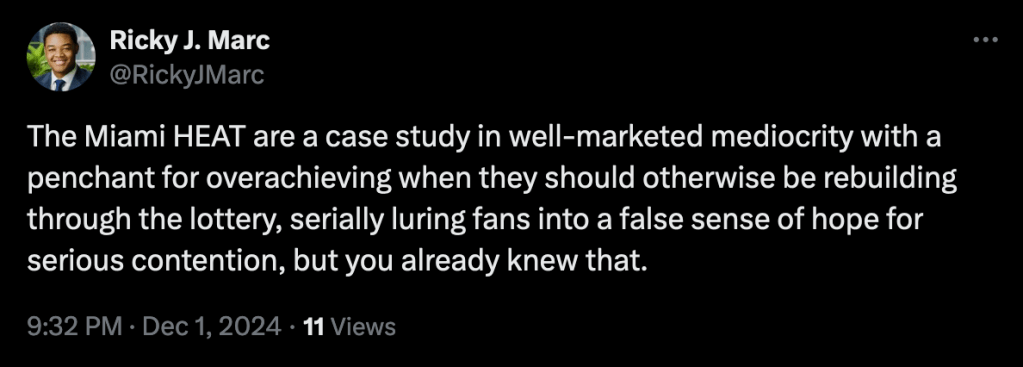
Remember my well-marketed mediocrity take? After years of recycled explanations, missed windows, and protected comfort, a fair question hangs over the franchise and its leadership: how much longer are HEAT fans expected to accept this as progress?
UGH.
For half a decade, the HEAT’s front office has asked its fan base to accept restraint as wisdom and patience as strategy. That request expired a long time ago. They also allowed its fan base to believe that they were in contention for championships every year, despite yearly Play-In appearances.
This latest deadline did not introduce a new failure. It confirmed a pattern that has now hardened into policy. The organization with one of the most recognizable brands in professional sports continues to operate without the urgency, adaptability, or risk tolerance required to compete for championships in the modern NBA.
It’s time for evidence over emotion.
The record is public. The standings are current. The transactions are traceable. The outcomes are repeatable. The HEAT have failed to deliver meaningful roster improvement at inflection points, failed to adjust their asset valuation to market realities, and failed to accept the risks that define successful franchises in this era.
THE STANDINGS DON’T LIE
As of February 2026, the HEAT sit squarely in the middle of the Eastern Conference. The record signals competence. It also signals stagnation. This is the same competitive lane Miami has occupied for most of the post-LeBron era: present, professional, and structurally capped.
Middle-seed positioning has become habitual. Play-in flirtation has become normalized. The front office continues to frame this outcome as sustainability. The league treats it as inertia. Sustainable contention requires upward pressure, whereas Miami applies downward caution.
INACTION AS ORGANIZATIONAL PHILOSOPHY
The 2026 trade deadline delivered clarity across the league. Teams with ambition acted. Teams with fear explained. Miami chose explanation.
While contenders consolidated talent and redefined timelines, the HEAT exited the deadline without a serious roster upgrade. This was not due to a lack of opportunity. It was the product of familiar internal limits: protected assets, constrained packages, and an aversion to discomfort.
This front office has now missed multiple elite acquisition cycles while maintaining public interest in every star market.
The pattern is consistent:
Miami appears in rumors.
Miami declines to meet price.
Miami exits with the same roster geometry.
Sound familiar? This is a case study in transactional paralysis.
REALITY BITES
The NBA has changed. Miami’s internal valuations have not. Across several seasons, the organization has overestimated the trade-market value of its secondary stars while underestimating the cost of acquiring top-tier talent. This mismatch has surfaced repeatedly in failed pursuits, stalled negotiations, and public posturing that collapses once real leverage is required.
Draft capital remains limited. Contract flexibility remains compressed. Young players are framed as untouchable until their market value peaks and opportunity evaporates. The result is a portfolio heavy on sentiment and light on mobility. Successful franchises treat assets as instruments. Miami treats them as symbols.
DEVELOPMENT: A SHIELD, NOT A STRATEGY
Player development has long been a legitimate strength of this organization. It has also become a convenient shield. Undrafted success stories and internal growth narratives are now used to justify inaction at the top of the roster. Development is valuable, but it does not replace elite creation, size, and shot-making in May and June.
The handling of Kel’el Ware crystallizes this contradiction. Ware has produced efficiently in unstable conditions. His minutes fluctuate. His role contracts. His accountability exceeds his insulation. This is framed as teaching. In practice, it places developmental burden on the player while structural flaws remain unaddressed.
Development requires continuity. Miami has provided volatility.
WHEN CULTURE TRUMPS EVOLUTION
HEAT Culture once functioned as a competitive edge. It now functions as insulation against critique. The league has evolved toward flexibility, player empowerment, and aggressive retooling. Miami continues to operate as if cultural capital offsets talent gaps indefinitely. It does not.
Culture cannot compensate for missing primary creation. It cannot close late-game shot deficits. It cannot overcome roster ceilings imposed by conservative asset management. When culture becomes explanatory instead of performative, decline follows quietly.
Successful cultures that have actually won championships, such as the San Antonio Spurs from 1991-2015 or the Los Angeles Lakers from 1979-1991, were built around real talents, not supporting characters from Rudy. Tim Duncan. David Robinson. Manu Ginobili. Tony Parker. Kareem Abdul-Jabbar. Magic Johnson.
You need talented A-level players to win.
LEADERSHIP WITHOUT ALIGNMENT
Pat Riley built a championship organization through boldness, disruption, and conviction. That legacy, thanks be to Dwyane Wade (whom Riley didn’t even want in the first place, but for Randy Pfund’s scouting eye), is secure.
The current execution does not reflect it. Erik Spoelstra continues to extract competitive coherence from incomplete, rosters. His adaptability has prolonged relevance while also masking front-office hesitation.
Coaching excellence has covered for executive restraint. That coverage is no longer sustainable. Words, rotations, and transactions require alignment. Miami’s leadership structure currently operates with misaligned incentives: protect identity, preserve assets, and hope performance bridges the gap.
Hope is not a strategy.
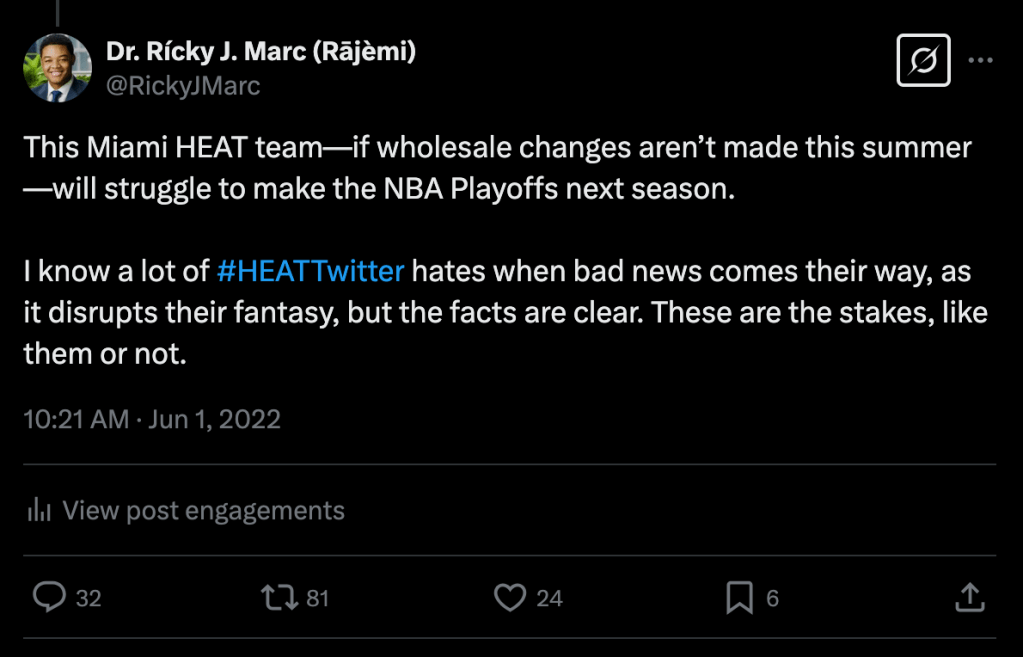
THE BUTLER ERA WAS A WARNING
Jimmy Butler delivered two Finals appearances through will, variance, and extraordinary playoff performance. Those runs were treated as validation. They were warnings. This outcome did not arrive suddenly but predictably.
The front office declined to capitalize aggressively during Butler’s window. Incrementalism replaced urgency. The roster aged. The ceiling lowered. The relationship fractured.
Players notice how franchises act when windows narrow. Agents notice how aggressively teams pursue improvement. The league notices who accepts risk and who explains restraint.
Miami’s reputation as a destination now carries caveats. The brand remains powerful. The pathway to contention appears conditional. That perception carries long-term cost.
WHAT ACCOUNTABILITY REQUIRES
The HEAT front office owes its fan base clarity and action. It owes a definitive direction on asset deployment. It owes alignment between development rhetoric and developmental practice. It owes a roster strategy that reflects modern championship economics rather than nostalgia for past formulas.
This does not require recklessness. It requires gainful conviction. The organization must decide whether it intends to chase titles or curate respectability. Both paths are valid. Only one aligns with the promises repeatedly made.
CASE CLOSED
For years, warnings were framed as impatience. Critiques were dismissed as noise. The outcomes now speak plainly.
The Miami HEAT have chosen caution over ambition at moments that demanded risk. They have preserved comfort while competitors have redefined ceilings. They have asked a loyal fan base to accept explanations instead of results.
That era must end. Championship franchises move when windows open. They do not wait for certainty. They create it. The league has already moved on. Miami now decides whether it will follow or continue explaining why it did not.