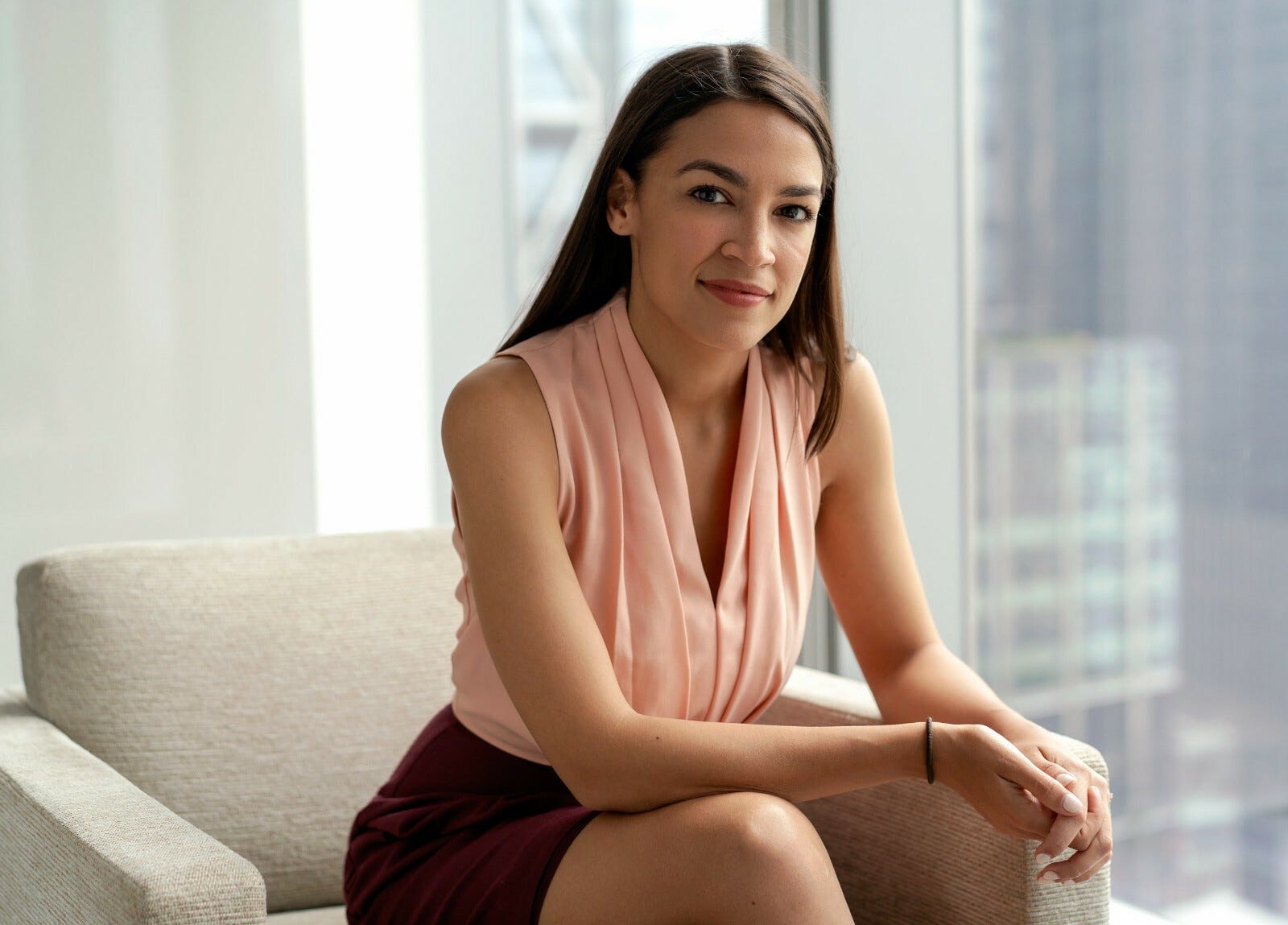
2028: AOC.
Meet Alexandria Ocasio-Cortez, the youngest woman ever elected to Congress. Could she be the youngest person ever elected President of the United States?

Alexandria Ocasio-Cortez is already one of the most powerful figures in Democratic politics. She is not powerful because of seniority. She is powerful because she commands attention, organizes loyalty, raises money, shapes language, and sets the emotional temperature for a large segment of the coalition.
In a Party that has struggled to produce authentic messengers who feel rooted in ordinary life, AOC remains the clearest proof that a politician can speak plainly and still be taken seriously.
That is the upside. The downside is structural. Presidential politics is a coalition test. It is a persuasion test. It is also a power test inside the Party. AOC triggers institutional reflexes that have been trained for decades to neutralize insurgent energy.
That dynamic sits at the center of her 2028 question, because the question is not only whether she wants the presidency. The question is whether the Party will permit a pathway to it without trying to control the outcome through pressure, endorsements, and elite coordination.
Reporting has already framed her 2028 choice as a fork in the road that could reshape national Democratic politics, including the possibility of a New York Senate challenge that would force a direct confrontation with Party leadership.
THE AOC QUESTION IS POWER, NOT HYPE
There are politicians who chase attention. AOC turns attention into leverage. Her relevance does not depend on a single cycle. It is built on a durable relationship with younger voters, small-dollar donors, and activists who see her as the most visible national translator of their concerns.
That relationship is why her team’s reported positioning for either a presidential or Senate run has been treated as consequential rather than speculative entertainment.
Her decision also matters because it would force Democrats to answer a question they keep dodging.
Will the Party build around the voters who bring energy and turnout, or will it keep treating those voters as a resource to be managed while nominating candidates chosen for donor comfort and institutional familiarity?
POLITICS THAT FEELS LIKE REAL LIFE
AOC’s most valuable asset is clarity. People who support her can usually say what she is fighting for without needing a prompt. She makes politics feel connected to rent, healthcare, wages, and dignity.
She also makes moral language sound like something other than branding. That matters in a country where voters increasingly assume politicians speak in approved scripts.
She is also expanding her portfolio. Her appearance at the Munich Security Conference this month was not an accident. It was an international-stage signal that she intends to be seen as more than a domestic protest figure.
That kind of visibility is how politicians prepare a national leap without saying they are preparing a national leap.
THE ONLY REAL LEFT LANE
If AOC ran in 2028, she would enter the field as the only nationally scaled candidate whose brand is identifiably progressive in substance, not just tone. Plenty of Democrats borrow progressive language.
AOC has spent years attaching her name to the agenda itself, defending it under pressure, and building the small-dollar and activist infrastructure that comes with it.
Her platform would basically write itself from her record. On healthcare, she lives in Medicare for All politics and treats universal coverage, medical debt, and price gouging as matters of law and enforcement.
On education, she has consistently framed tuition-free public college and trade school and broad student-debt cancellation as economic freedom, not a personal-finance lecture.
On wages and labor, she’s been a $15 minimum wage figure and a pro-union politician who talks about bargaining power as the core of democracy.
On climate, the Green New Deal remains her signature governing framework because it welds jobs, infrastructure, and decarbonization into one national mobilization project.
On corporate power, she has made antitrust and market concentration a headline issue, treating monopoly power as a direct driver of higher prices and political corruption.
On immigration, her instincts run toward structural reform and abolition language on ICE because she reads the enforcement machinery as a civil-rights problem, not a branding exercise.
On foreign policy, her strongest argument is coherence: human rights standards that actually constrain weapons, aid, and impunity, tied to the same working-class material politics she sells at home.
HER WEAKNESS
AOC’s challenge is not enthusiasm, however. It is scale. Democratic primaries are not won through applause lines alone. They are won through coalition coverage across regions, age groups, ideological subcultures, and class segments that do not automatically trust each other.
A candidate can dominate youth voters and still lose a primary if older voters, Black voters in key states, and suburban swing voters do not come along in sufficient numbers, especially if the powers that be mobilize against her as they did when Bernie Sanders proved a threat to the liberal establishment.
The general-election map adds another layer. A Democrat who cannot credibly compete in the Midwest battlegrounds and key Sun Belt states places the Party into defensive posture immediately. She will need to demonstrate that ability in the primaries.
AOC can build that credibility. It requires discipline and repetition around material politics, plus a refusal to let the campaign get trapped in symbolic fights that are designed to isolate her from persuadable voters.
THE “BLOOP” MOMENT WAS SMALL, AND IT REVEALED A LOT
When AOC responded Bloop! to a hypothetical head-to-head poll, it was treated as a joke and as a tell. The coverage and the reaction proved something practical: she understands the modern attention environment, and she knows how to project confidence without writing a formal announcement.
That moment also revealed a risk. Politics that lives too comfortably in viral gesture becomes easy to caricature. Opponents will frame her as vibes and provocation.
Her job is to keep the internet layer from becoming the main story. The campaign has to remain anchored in affordability and governance, said in plain language, with enforceable commitments.
FOREIGN POLICY AND SECURITY
If AOC wants the presidency, she will be tested hard on foreign policy. That is already happening. Her Munich remarks drew attention precisely because they placed her on a global stage talking about authoritarianism, inequality, and U.S. credibility.
The scrutiny will increase. She will be challenged on clarity, consistency, and seriousness.
The most durable way for her to pass that test is to treat foreign policy as an extension of material life. Wars affect prices. Sanctions affect supply chains. Defense spending affects domestic budget priorities.
Migration is tied to instability. Voters can understand this. They also respect candidates who speak about human rights as policy rather than as posture.
THE PARTY’S REFLEX WILL BE THE FIGHT
AOC’s hardest obstacle sits inside her own Party. Modern Democratic presidential politics has a well-developed immune system.
When an insurgent candidate starts looking viable, the response forms fast: coordinated endorsements, donor consolidation, electability storylines, and media narratives designed to narrow the field around a preferred alternative.
AOC can beat that structure. The route runs through a disciplined synthesis of two movements that already proved they can move real human beings at scale.
Obama’s 2008 operation showed what happens when a campaign turns hope into an organizing method, converts enthusiasm into turnout, and builds legitimacy through mass participation and small donors.
Sanders proved that an openly populist, anti-oligarch message can become a durable fundraising engine powered by ordinary people giving repeatedly, plus a political identity that supporters treat like a cause rather than a candidate.
AOC has her own proof-of-concept, and it matters. In 2018, she beat Joseph Crowley in a primary that most institutional actors treated as unwinnable, and she did it with grassroots infrastructure and insurgent legitimacy.
Zohran Mamdani’s 2025 NYC mayoral win offers the modern municipal blueprint: a multiracial coalition, a turnout surge, and a simple affordability frame that stayed central—rent freeze, free buses, expanded childcare—while the campaign scaled from movement energy into a citywide governing mandate.
AOC’s path in 2028 looks like that: revolutionary energy treated as an operational asset, an affordability-centered message treated as the spine of the campaign, and a field strategy built to win early states through persuasion and turnout rather than pundit permission.
Eight years of Trumpian fascism and four years of toothless Biden neoliberalism leave a vacuum. A disciplined progressive project can feel like oxygen in the same way Obama’s message felt like oxygen in 2008.
THE VERDICT
AOC is a real 2028 contender because she already operates like a national figure and because credible reporting has described her operation as preparing for a major 2028 move.
She has the ability to mobilize energy that Democrats routinely fail to generate. She has the communication talent to define a race around affordability and power.
She also faces the hardest internal resistance of anyone in the field because her ascent would force the Party to confront its own habits.
Her path to viability runs through coalition expansion, governing credibility, and disciplined focus on material life. If she builds that, she becomes a serious threat in the primary.
If she does not, she remains a dominant voice in the Party without holding the nomination.