
FARCE.
Venezuela deserves a democracy that is built on justice, not economic strangulation and foreign manipulation.

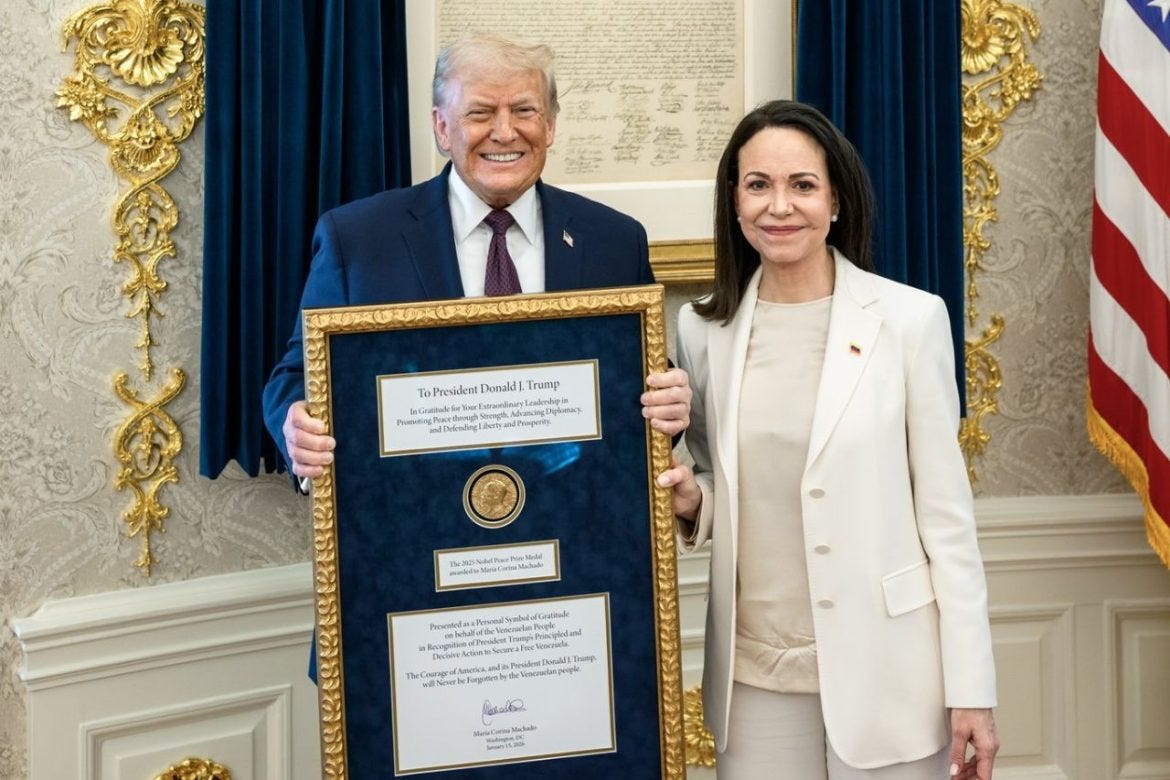
The Nobel Peace Prize was once presented as humanity’s highest moral acknowledgment—a recognition of those who advanced the cause of peace, justice, and human dignity. In 2025, that pretense collapsed under the weight of its own hypocrisy.
The award’s presentation to Venezuelan politician María Corina Machado marks a new descent into farce, confirming what has long been evident: the Nobel Committee no longer honors peace. It rewards allegiance to empire.
Machado, a figure defined by her alignment with the Venezuelan and international right, has repeatedly supported interventionist agendas that would plunge her country into deeper instability.
Her record is public and unambiguous. She has endorsed U.S. sanctions that have crippled Venezuela’s economy, pushed for the recognition of unelected opposition figures, and courted figures such as Marco Rubio and Mike Pompeo—politicians who have openly discussed regime change. Her commitment is not to Venezuelan sovereignty but to Washington’s hemispheric strategy.
That such a figure could receive a prize purportedly dedicated to peace speaks volumes about what “peace” now means in the language of empire.
The Nobel Committee described her as a tireless defender of democracy and human rights. In reality, she has championed policies that intensify collective suffering.
Economic sanctions have killed quietly—through starvation, medical collapse, and forced migration. Each time a Venezuelan child dies from a lack of medicine or an elderly citizen cannot access food, the machinery of Western policy grinds forward. Machado has not opposed that machinery. She has helped construct it.
MANUFACTURED MORALITY
This award cannot be understood in isolation. It is part of a global pattern of ideological consolidation, where the institutions of liberal democracy mask their complicity in structural violence through selective celebration.
The Nobel Peace Prize has often been deployed as a legitimizing tool for Western narratives, laundering interventionism through the language of moral virtue.
When Barack Obama received the prize in 2009 as the shadows of his eventual drone warfare began to grow, or when the European Union was honored in the midst of its border militarization, the message was clear: peace is defined not by the cessation of violence but by its refinement.
By honoring Machado, the Committee once again recasts imperial policy as humanitarian concern. Venezuela’s crisis—exacerbated by sanctions, political interference, and economic sabotage—is reframed as an internal failure solvable only through foreign-approved actors.
Machado’s image as a reformer thus becomes useful. It gives Western governments the veneer of benevolence while deepening their economic and geopolitical reach.
The prize functions as a symbolic currency, affirming loyalty to neoliberal orthodoxy under the guise of civic virtue.
This is why the Nobel Committee’s decision carries geopolitical weight. It signals to the Global South that the path to international legitimacy runs through compliance.
Resistance—whether socialist, nationalist, or populist—is punished; submission is sanctified. Institutions like the Nobel Foundation operate as extensions of soft power, defining moral boundaries for the world while exempting Western powers from their own crimes.
The occupation of Palestine, the devastation of Iraq, and the plundering of Africa never disqualify the architects of these atrocities from moral leadership. The machinery of recognition remains internal to empire.
SELECTIVE MEMORY
The tragedy of Venezuela lies not only in the authoritarianism of Nicolás Maduro but in the systematic erasure of the nation’s complex political struggle.
As I have previously written elsewhere, Chavismo once represented a real alternative—a project rooted in redistribution, participatory democracy, and regional independence.
Its degeneration into corruption and repression is undeniable. Yet the crisis that followed has been deliberately compounded by external aggression designed to engineer collapse and justify intervention.
Washington’s policy toward Venezuela has never been humanitarian. It has been strategic. Sanctions were imposed not to restore democracy but to cripple a state that defied U.S. financial control.
These sanctions have starved hospitals, wrecked infrastructure, and driven millions into exile. And yet, the architects of these policies continue to present themselves as defenders of freedom.
Machado’s alignment with this apparatus places her firmly within the architecture of Western domination. Her Nobel Prize is therefore not an anomaly—it is the reward of a system that equates obedience with virtue.
The Western media will celebrate this award as a triumph of democracy over tyranny. The Venezuelan people, however, know what such narratives conceal.
They have lived through the collapse of the Bolivarian project, the suffocation of economic warfare, and the despair of forced migration. They understand that peace without sovereignty is submission, and democracy imposed by foreign powers is another form of colonial rule.
THE PEACE INDUSTRY
The Nobel Peace Prize has become a cornerstone of the global peace industry—a vast network of institutions, NGOs, and foundations that operate as moral brokers for the imperial order. Its function is ideological, not humanitarian.
By selectively elevating certain figures while ignoring others, it constructs a hierarchy of virtue that mirrors the hierarchy of global power. Those who serve Western interests are praised as defenders of freedom. Those who resist are denounced as threats to stability.
This pattern has repeated itself for decades. The Nobel Committee has rewarded leaders who presided over occupation, militarization, and austerity while ignoring liberation movements that fight against them.
Palestinian freedom activists remain unacknowledged. Whistleblowers who expose war crimes are imprisoned or exiled. The people who resist exploitation are never deemed peaceful. The people who manage it are.
The 2025 award confirms that the Nobel Peace Prize no longer honors moral courage. It rewards narrative conformity.
By celebrating Machado, the Committee reaffirms that peace is not the absence of violence but the successful administration of empire. The prize has become an annual ritual of moral laundering—an exercise in absolution for those who manufacture suffering under the banner of civilization.
THE MEANING OF RESISTANCE
Venezuela deserves democracy. But democracy cannot be built on the foundations of economic strangulation and foreign manipulation. The people of Venezuela have the right to self-determination free from both Maduro’s repression and Washington’s domination.
The Nobel Committee’s decision obscures that truth by presenting imperial collaboration as moral heroism.
True peace is born of justice, not submission. It requires dismantling the structures that perpetuate inequality and foreign dependency. It demands recognition of those who struggle against both authoritarian states and the empires that sustain them.
It does not come from Oslo or Washington. It arises from the streets, the unions, the barrios, and the refugee camps—from people who fight for life itself.
The Nobel Peace Prize once aspired to honor such struggle. It now serves to conceal the crimes of those who suppress it.
By awarding María Corina Machado, the Committee has not advanced peace—it has endorsed a global order that mistakes domination for virtue and silence for stability.
The farce is complete, and the empire applauds its own reflection.