
NO, TIGER.
It's time to be honest about golf's greatest gamer, once and for all.

Tiger Woods built one of the greatest careers any athlete has ever assembled. He won 15 majors, tied the PGA Tour record with 82 victories, changed the commercial scale of golf, and turned himself into one of the defining sports figures of the last thirty years.
Those facts are permanent. They sit in the record book and they are not going anywhere. The other fact is sitting right beside them now.
On 27 March 2026, Woods was arrested in Florida after a rollover crash and charged with DUI with property damage and refusal to submit to a lawful test.
Authorities said he showed signs of impairment. He blew 0.00 on a breath test and refused a urine test. That sequence is public, documented, and ugly.
GREATNESS DOES NOT GRANT IMMUNITY
The core issue is simple. A man with Tiger Woods’s resources, visibility, age, and history chose once again to put himself behind the wheel under a cloud of impairment. That is reckless. It is selfish. It is dangerous.
It carries the same contempt for consequence whether the substance is alcohol, prescription medication, another drug, or some combination still unknown to the public. The road does not care about celebrity.
The truck he clipped did not care about his trophy case. The people sharing that road did not consent to becoming background characters in another chapter of Tiger Woods’s chaos.
This is not an isolated lapse. AP describes the March 2026 crash as at least Woods’s fourth high-profile car incident and his second DUI-related arrest. In 2017, he was found asleep in a car stopped in a traffic lane, later entered a first-time offender program, and ultimately pleaded guilty to reckless driving.
In 2021, he crashed at high speed in California and suffered severe leg injuries. In 2009, he crashed outside his home during the implosion of his marriage and public image.
A pattern this long has its own voice. It speaks clearly. It says the man at the center of it has not mastered himself.
PRIVACY IS NOT A DEFENSE
The latest twist makes the whole thing even smaller. People reported that Woods refuses to hire a driver because he does not want anyone to watch over him or know what he is doing, and because he believes he is fine to drive.
If that reporting is accurate, then Woods has reduced a public-safety issue to a private-comfort issue. He is choosing secrecy over responsibility. He is choosing ego over precaution.
He is choosing the illusion of control over the obvious duty to protect other people from his instability behind the wheel.
That rationale deserves contempt. A billionaire athlete with every available resource on earth does not get to hide behind inconvenience. He can hire a driver. He can call for a ride. He can surrender the keys.
He can structure his life around the reality that pain, medication, injury, age, and judgment do not always mix safely. Every ordinary person is expected to understand that. Tiger Woods is expected to understand it too.
His preference for privacy carries no moral force when it endangers the public.
THE PUBLIC HAS SEEN THIS MOVIE BEFORE
Woods spent years constructing an image of total control. Then the seams split open. The 2009 infidelity scandal shattered the corporate myth around him, cost him major sponsors, and led to the kind of televised apology that only arrives after a man has already detonated his own life.
He admitted then that he felt entitled, that he believed rules did not fully apply to him, and that he had behaved foolishly. Sixteen years later, the old disease still looks familiar. The details have changed. The arrogance has not.
That is why this moment feels so exhausted and so infuriating. The public is not dealing with a single bad night. The public is looking at a durable pattern of indulgence, concealment, recklessness, and reassembly.
Woods falls. The machine pauses. The apology arrives. The brand survives. The sport makes room. Then the next mess shows up. At a certain point the cycle stops being tragedy and starts looking like permission.
THE BLACKNESS QUESTION NEVER FULLY WENT AWAY
Tiger Woods’s relationship to Black public feeling has always been uneasy. He described himself in 1997 as Cablinasian, a term he coined to describe his mixed heritage, and that choice drew criticism from some Black golfers, writers, and fans who felt he was keeping Blackness at arm’s length even while benefitting from being read as a racial pioneer in a historically exclusionary sport.
Woods has every right to define his own identity. The backlash was real anyway. It became part of the public story around him and never fully disappeared.
That history matters here because Tiger was never simply a golfer. He became symbol, projection, aspiration, argument, and cultural dispute all at once.
Many Black Americans saw a door opening in a sport built by money, exclusion, and country-club gatekeeping. Many also watched him refuse a simpler racial script that they felt history itself had already written around his rise.
That distance shaped how his falls were read. It shaped how his scandals were processed. It shapes this moment too. Some people see a wounded icon. Some people see a gifted man who keeps choosing disgrace.
Both reactions exist because both histories exist.
THE ROT THICKENS
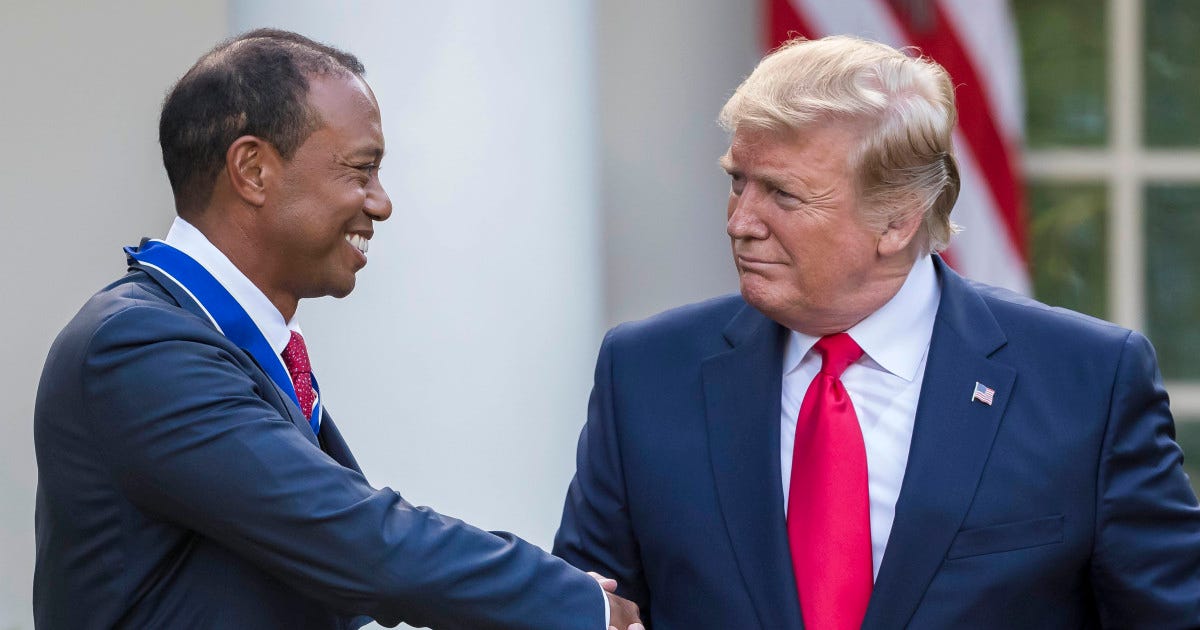
Tiger Woods’s visible closeness to Donald Trump deepens the disgust around this latest crash. Trump awarded Woods the Presidential Medal of Freedom in 2019.
Woods then appeared with him again at the White House in February 2025 during a Black History Month event, and Reuters reported after the March 2026 arrest that Trump described Woods as a personal friend.
Those are not random overlaps. They show a sustained comfort with one of the most poisonous political figures in modern American life.
That history lands especially hard for Black observers because Woods already carried a long public tension around race, distance, and identity. His willingness to remain close to Trump adds another layer of rot to that story.
The recklessness on the road is one indictment. The company he keeps is another. Put together, they reveal a man whose gifts were historic and whose judgment has too often been disgraceful.
GOLF HAS ENABLED THIS TOO LONG
The Guardian put the larger institutional question plainly this week: why is golf still so beholden to Tiger Woods? It is the right question.
Woods still pulls oxygen in a sport that has struggled for years to imagine its own future without him. He still carries enormous symbolic power in PGA Tour politics, media attention, fan engagement, and ceremonial relevance.
That dependence has made golf timid. It has made golf sentimental. It has made golf too willing to keep treating Tiger Woods as a permanent exception.
Respecting what he achieved on a golf course does not require endless indulgence off it. The sport has younger stars. The sport has major champions. The sport has fresh rivalries and fresh audiences to build.
Golf’s refusal to emotionally decouple itself from Woods has helped create a moral haze around him. Every new incident is greeted with concern, sadness, disappointment, and hand-wringing.
Those words are soft. They do not match the danger. A man rolled a vehicle after showing signs of impairment. That belongs in the language of accountability.
A FAMOUS MAN CAN STILL BE PATHETIC
The saddest part of Tiger Woods now is how small the story has become. The athlete who once bent the entire sport around his will is standing inside a narrative about refusal, secrecy, medication, wreckage, and an apparent inability to accept his own limits.
People reported that those around him are saying he needs to act his age. They are right. He is 50 years old. He is a father. He is one of the richest athletes in modern sports history.
He is old enough to know that self-pity is useless and that irresponsibility behind the wheel can kill people.
Public sympathy has conditions. Serious injury earns sympathy. Chronic pain earns sympathy. Grief earns sympathy. Human frailty earns sympathy.
Repeated refusal to take the obvious responsible path burns sympathy away. Woods had options before this crash. He has options now.
He can get treatment. He can step back. He can stop driving. He can stop pretending privacy is a principle grand enough to justify public risk.
He can finally behave like someone who understands that the world around him contains other lives.
FINAL VERDICT
Tiger Woods remains one of the greatest golfers who ever lived. Tiger Woods also looks, in this moment, like a deeply undisciplined man who keeps dragging his own legend through preventable disgrace.
The split between those two truths is the whole story. Talent gave him glory. Character was supposed to govern the rest. It has failed him too many times, and this latest episode carries a sharper edge because it could have ended with bodies on the road instead of metal on its side.
He deserves due process on the specific charges. He deserves no coddling for the conduct that brought him there.
A fifty-year-old billionaire sports icon with a long public history of vehicular chaos has no moral case left for childish recklessness. He needs consequences. He needs intervention.
He needs to get off the road before his next headline becomes someone else’s obituary.