
TEXAS.
Did Democrats just waste a major opportunity to fully flip Texas blue this year?

What a night!
Texas Democrats entered the 2026 cycle with a rare alignment of talent, demographic momentum, and national political conditions that favored disruption. The state’s electorate has grown younger, more urban, and more multiracial with each passing cycle.
Republican dominance has endured through structural advantages and disciplined messaging, yet the margins have tightened enough to create genuine opportunities for an organized opposition.
The Texas Democratic primary should have been the moment when the party acted with strategic clarity.
Instead, the outcome delivered a portrait of organizational drift. State Representative James Talarico secured the Democratic nomination for the United States Senate.
Representative Jasmine Crockett exited the contest after a bruising campaign marked by racially-charged allegations of voting irregularities in Dallas County.1
In the gubernatorial primary, Gina Hinojosa emerged as the nominee to challenge Governor Greg Abbott.
The result fractured the strongest potential tandem into disconnected campaigns and eliminated the possibility of a coordinated statewide narrative built around complementary political strengths.
Texas required disciplined political architecture. It received consultant-driven improvisation.
THE PRIMARY FIASCO
James Talarico’s Senate primary victory represents a moment of opportunity and limitation at the same time.
His public persona carries moral seriousness and policy fluency that resonate with suburban voters who remain skeptical of the Republican Party’s ideological direction yet hesitant about the Democratic brand.
His profile fits the kind of candidate capable of competing in counties that have gradually moved toward the center of the political spectrum.
Jasmine Crockett represents a different form of political energy. Though lacking the policy-driven substance of the Talarico campaign, her confrontational clarity during congressional hearings, her media presence, and her capacity to galvanize urban constituencies have established her as one of the Democratic Party’s most visible communicators.
In a state where turnout gaps in Black, Latino, and youth communities routinely determine electoral margins, that capacity for mobilization carries measurable electoral value.
The primary outcome separated those strengths rather than aligning them. Talarico moved into a Senate race that demands broad persuasion across ideological lines.2
Crockett left the contest entirely. Hinojosa inherited the gubernatorial nomination without the national profile capable of reshaping the race’s media environment.
Texas politics rewards coordinated narratives. The 2026 Democratic primary produced fragmented messaging and divided attention.
A VANISHING OPPORTUNITY
A statewide strategy built around complementary leadership could have altered the psychological landscape of the election cycle.
Jasmine Crockett campaigning for governor would have carried the energy of a movement candidacy rooted in urban turnout and racial justice politics.
James Talarico running for Senate could have spoken to economic fairness and institutional stability, which it did.
Such a configuration produces political multiplication. High-energy mobilization expands turnout in major metropolitan counties. Persuasive outreach stabilizes support in suburban districts that determine statewide margins.
Each candidacy strengthens the other by widening the electorate while reducing ideological anxiety among swing voters.
Texas elections frequently hinge on permission structures. Voters look for signals that participation in change carries legitimacy.
A coordinated Democratic ticket combining Crockett’s mobilizing force with Talarico’s bridge-building appeal would have provided that signal to millions of voters who currently approach statewide elections with skepticism.
The 2026 primary, thanks to a series of ruinous consultants providing horrendous advice that the Crockett camp unfortunately invested in, removed that possibility. Let’s get into that.
CONSULTANT PATHOLOGY
The internal culture of modern Democratic consulting rewards procedural management rather than structural transformation.
Campaigns operate as discrete enterprises with their own donor networks, polling contracts, media strategies, and advisory ecosystems. Strategic integration across campaigns rarely becomes the central objective.
This professional ecosystem encourages tactical caution. Consultants measure success through short-term metrics such as message discipline, fundraising stability, and media impressions.
Structural experiments that require coordination across multiple races introduce professional risk and organizational complexity.
Texas Democrats therefore approached the 2026 cycle through familiar frameworks. Each race received separate planning. Each campaign built its own messaging apparatus.
Each candidate competed for attention within the same donor universe. The result resembled a portfolio of isolated campaigns rather than a statewide movement with unified strategic direction.
Political organizations that operate this way maintain stability. They rarely generate breakthroughs.
Put simply, these are the same losers responsible for Virginia turning red in 2021, Florida losing what little Democratic Party influence it had left post-Obama, the failed Cuomo campaign, and so many others that have seen MAGA’s influence flood the nation.
RACIAL CAUTION & POLITICAL LIMITATION
Another dimension of the party’s internal caution emerges in the treatment of charismatic Black leadership within statewide electoral planning.
National Democratic institutions frequently celebrate the communication skills of figures such as Jasmine Crockett while hesitating to place them at the center of high-risk statewide contests.
This dynamic shapes candidate placement. Leaders with strong media profiles remain in congressional roles or national advocacy circuits.
Statewide races receive candidates whose profiles appear less polarizing to institutional donors and suburban voters.
Texas politics operates within a demographic landscape where Black turnout remains central to Democratic competitiveness.
Mobilization requires visible leadership capable of speaking directly to the communities whose participation determines electoral margins.
Political caution that restricts such leadership narrows the electorate before the campaign even begins.
The consequences appear in turnout statistics every cycle.
THE SQUANDERED GOVERNOR’S RACE
Governor Greg Abbott entered the 2026 election with the perceived advantages of incumbency, institutional infrastructure, and a vast fundraising network.
Any Democratic challenger would confront steep structural obstacles. Yet gubernatorial campaigns function as organizing engines regardless of their final vote totals.
A high-energy gubernatorial campaign can build local networks in counties that lack year-round party infrastructure. It can expand voter registration programs in urban districts where demographic growth outpaces political engagement.
It can introduce new ideological frames around education, healthcare, infrastructure, and economic opportunity.
Those campaigns reshape the political environment even when victory remains distant. They create data infrastructure, activist communities, and voter relationships that persist across election cycles.
The Democratic primary did not produce such a campaign.
TALARICO’S MOMENT
James Talarico now carries the responsibility of representing the Democratic Party in a statewide Senate contest. His rhetorical style emphasizes ethical seriousness, public service, and faith-informed civic duty.
Those themes resonate with constituencies that remain reachable within the Texas electorate, and last night’s results made it abundantly clear that he has the wherewithal to accomplish this task.
Success in this race requires a campaign that speaks to the state’s economic anxieties and institutional frustrations.
Public education funding, reproductive rights, healthcare access, and cost-of-living pressures shape daily life across the state’s metropolitan corridors and rural communities alike.
Talarico possesses the communication discipline necessary to articulate those issues with clarity. His challenge lies in constructing a coalition that stretches from progressive urban voters to suburban moderates who seek stability within public institutions.
The campaign’s direction will determine whether the Democratic Party expands its electoral map or simply preserves existing support. By all metrics, it appears that Talarico will be tapping into a unique voter base of his own, not unlike the successful Mamdani for New York campaign in 2025.
BATTLEGROUND: TEXAS
Texas occupies a unique place within the American political system. Its population growth, economic scale, and electoral weight position it as one of the most consequential states in national politics.
Every election cycle that passes without meaningful competition strengthens the governing party’s institutional advantages.
Democratic competitiveness in Texas requires long-term infrastructure, disciplined messaging, and leadership capable of mobilizing a diverse electorate. Each statewide campaign becomes an opportunity to build that infrastructure.
The 2026 primary produced a narrower foundation than the moment allowed.
THE PATH FORWARD
Texas Democrats still possess time to reshape the political environment of the general election. James Talarico can pursue a campaign grounded in economic fairness, democratic accountability, and respect for public institutions.
Jasmine Crockett can serve as a statewide surrogate whose communication skills energize turnout in communities that historically remain underrepresented at the polls. I am not optimistic that she will truly barnstorm Black communities on Talarico’s behalf.
Coordinated organizing across counties, school boards, and municipal offices can strengthen the party’s grassroots presence.
Investment in voter registration and year-round engagement can expand the electorate beyond traditional midterm participation levels.
Political transformation requires sustained effort and strategic discipline. Texas offers the demographic foundation for such change.
The events of the 2026 primary illustrate how fragile that opportunity remains. Let’s see what happens next.
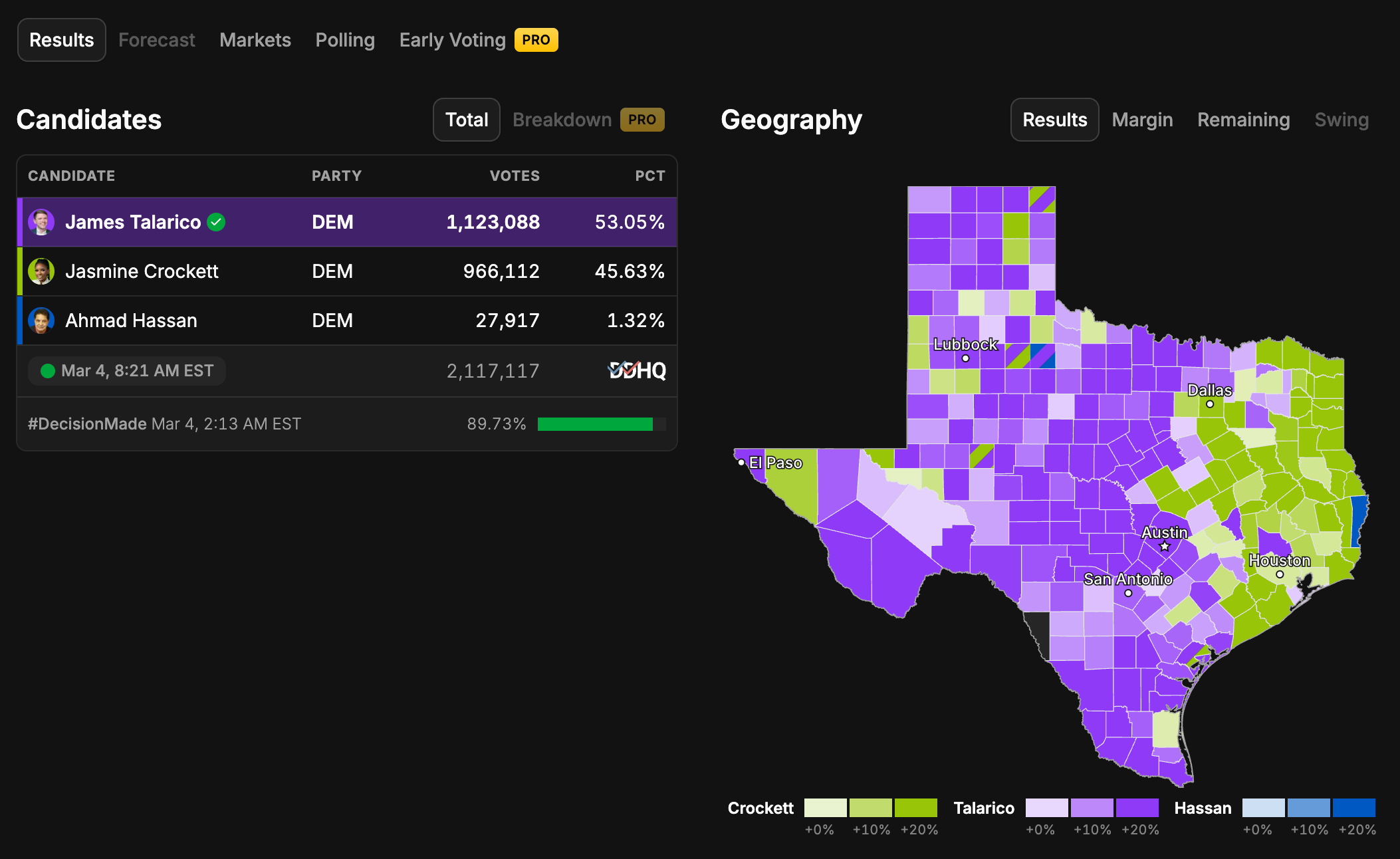
It’s a long road to November.
In fairness, voter suppression has been nothing new in Texas, but the way in which the Crockett campaign attempted to racialize this race when Talarico desired nothing of the sort is a relic of the same tired brand of identity politics employed by failed candidates and their supporters like Kamala Harris in 2024, Val Demings in 2022, Kamala Harris again in 2019-20, and Hillary Clinton in 2016. When will liberal consultants learn? Your guess is as good as mine.
Which, beyond the Black vote, he absolutely crushed, to his credit.